Fatty liver is a metabolic disease — and it deserves an endocrinologist.
The liver is the control center of your metabolism. When fat builds up in it, the same insulin resistance that drives type 2 diabetes is at work — and the risk reaches your heart, your kidneys, and your blood sugar long before it reaches cirrhosis. Here is what MASLD and MASH are, how we find the patients at risk, and how we treat the metabolism behind them — written by the endocrinologists who manage it every day, with every recommendation graded honestly by the evidence.
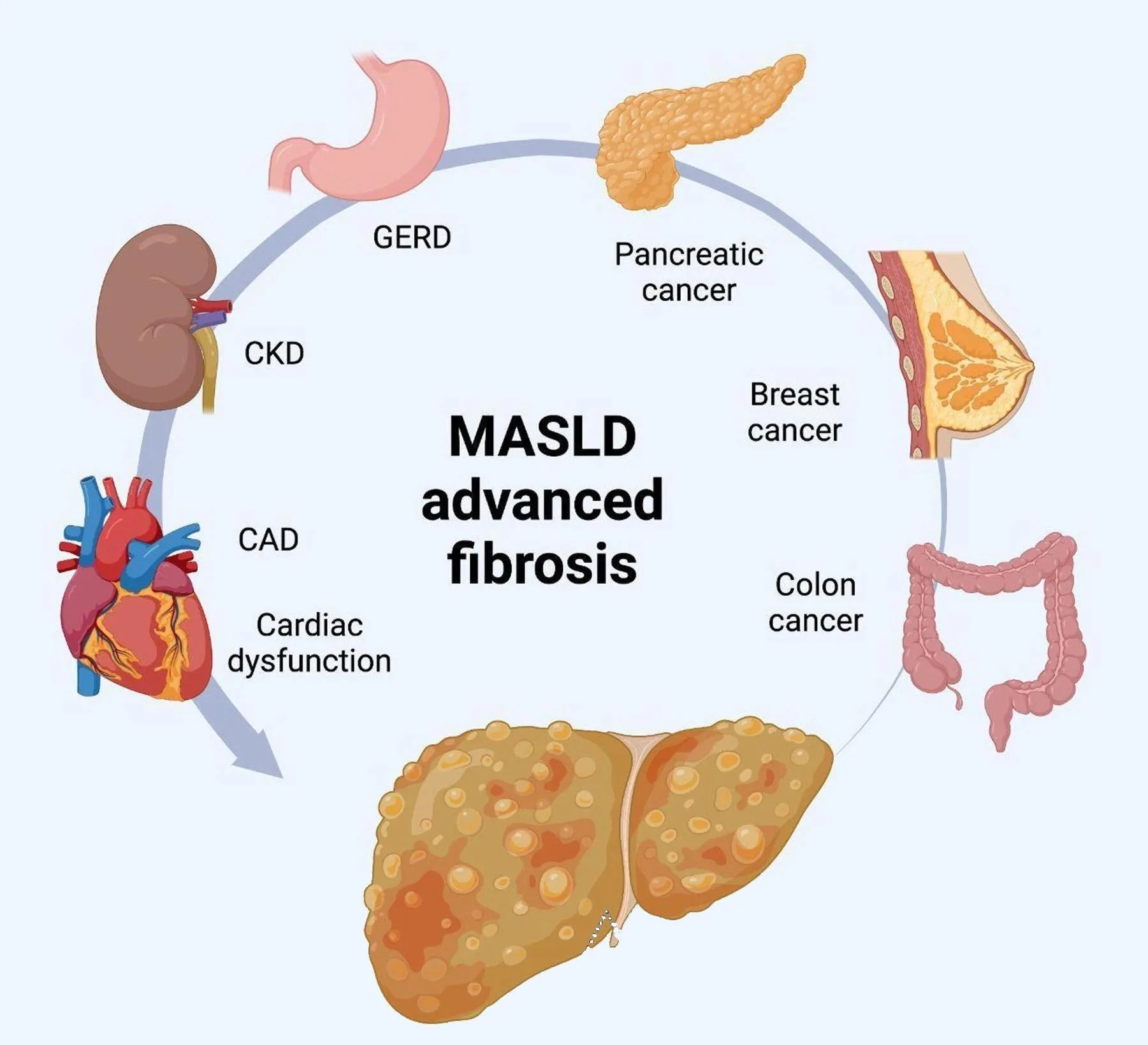
Figure adapted (cropped) from Liguori A, et al. MASLD beyond the liver: a systemic driver of cardiovascular, renal, and oncologic risk. Curr Hepatol Rep. 2026;25:16. doi:10.1007/s11901-026-00732-y · CC BY 4.0
"I have type 2 diabetes and my ultrasound says 'fatty liver' — is that serious?"
Explore this pathway →Where are you right now?
However you found this page, begin with the situation that sounds like yours.
I was told I have a fatty liver
What MASLD and MASH actually mean, and why "just a little fat in the liver" is not a throwaway finding.
Understand the basics →I have diabetes or heart risk
Why fatty liver and type 2 diabetes feed each other — and why heart disease is the leading cause of death in MASLD.
See the connections →My FIB-4 or elastography was abnormal
What the numbers mean, what fibrosis stage they suggest, and when it is time for a liver specialist.
Read your results →I've been offered medication
Semaglutide, resmetirom, pioglitazone — an honest look at what each does for the liver and for the rest of you.
Compare the options →MASLD is the liver's version of metabolic disease — not a separate problem.
About one in three adults has fat in the liver driven by insulin resistance, excess weight, high blood sugar, high triglycerides or high blood pressure. That is metabolic dysfunction-associated steatotic liver disease (MASLD). In a subset, the fat inflames and injures the liver — MASH — and scar tissue (fibrosis) can build toward cirrhosis. The good news: the same hormonal and metabolic levers that treat diabetes and obesity treat the liver.
The liver runs your metabolism
It stores and releases sugar, builds and exports fat and cholesterol, and responds to insulin, thyroid hormone, and gut hormones. When it fills with fat, all of that goes wrong.
It's a continuum
Fatty liver → MASH → fibrosis → cirrhosis. Most people never progress — but fibrosis is the single strongest predictor of who will, and it can be measured without a biopsy.
The heart is at greater risk than the liver
For most people with MASLD, cardiovascular disease — not liver failure — is the leading cause of death. The kidneys and blood sugar are at risk too.
It's treatable
Weight loss of 7–10% can reverse MASH, and two medicines — semaglutide and resmetirom — are now FDA-approved for MASH with moderate-to-advanced fibrosis.
Every article on this site includes
Guideline recommendations · evidence summaries graded A–E · the clinical controversies stated plainly · clear lines for when we bring in a liver specialist or cardiologist · and primary references you can check yourself.
MASH is managed as part of integrated cardiometabolic care — not as an isolated liver problem.
Fatty liver, type 2 diabetes, obesity, high blood pressure, abnormal lipids, kidney disease and heart disease share one engine: insulin resistance. Treating the liver in isolation misses the conditions most likely to cause harm — for most people with MASLD, that is the heart, not liver failure. So we stage the liver and treat the metabolism in the same visit.
Same visit, whole picture
FIB-4, in-office elastography and liver-fat measurement sit alongside A1c, blood pressure, lipids, kidney function and weight.
One plan, several organs
We favor treatments that help the liver and protect the heart and kidneys — GLP-1–based therapy, SGLT2 inhibitors, statins, and liver-directed drugs when fibrosis calls for them.
Early, not late
Diabetes and metabolic clinics are where fibrosis risk is found earliest. We screen at-risk patients routinely instead of waiting for abnormal liver tests.
Hepatology when it matters
Diagnostic uncertainty, advanced fibrosis, cirrhosis or complex liver disease go to hepatology — while we keep treating the metabolism behind it.
Understand every part of the condition — at the depth you want.
A layered library written for patients, clinicians, and researchers alike. Every article states plainly what is established, what is emerging, and what is still unproven.
Understanding MASLD & MASH
The liver as a metabolic organ, the new names, and the continuum from fatty liver to cirrhosis.
Explore →Causes: An Endocrine Disease
Insulin resistance, type 2 diabetes, visceral fat — and the thyroid, sex-hormone and pituitary conditions that drive liver fat.
Explore →Heart, Kidney & Liver Risk
The two-way links with cardiovascular disease, chronic kidney disease and type 2 diabetes — and cirrhosis and liver cancer.
Explore →Diagnosis & Staging
FIB-4 and in-office shear-wave elastography — how we stage fibrosis without a biopsy, and when we refer.
Explore →Treatment
Semaglutide and incretin therapies, resmetirom, pioglitazone, and protecting the heart and kidneys — graded honestly.
Explore →Nutrition & Lifestyle
How much weight loss is enough, Mediterranean eating, sugar and fructose, exercise, alcohol and coffee.
Explore →Research & Future Therapies
FGF21 hormones, dual and triple agonists, and the push to treat cirrhosis itself.
Explore →When We Refer
Advanced fibrosis, cirrhosis, coronary disease, complex lipid disorders — where our care hands off, and to whom.
Explore →Myths & "Liver Detox"
Milk thistle, cleanses and detox teas — what the evidence actually supports.
Explore →Screen. Treat the metabolism. Track — and refer when it matters.
MASLD is managed as what it is: a metabolic disease with a liver-specific danger signal. We look for that signal, treat the engine behind it, and know exactly when the liver needs a hepatologist.
Screen
Everyone with type 2 diabetes, prediabetes with risk factors, obesity with metabolic risk, or a fatty liver on imaging gets a fibrosis risk check — a FIB-4 from routine labs, followed by shear-wave elastography in our office when the FIB-4 is not clearly low. Normal liver enzymes do not rule out fibrosis.
Treat the metabolism
Weight, insulin resistance, blood sugar, blood pressure and lipids are treated together — with therapies chosen because they help the liver and the heart and kidneys: semaglutide or tirzepatide, pioglitazone, SGLT2 inhibitors, statins, and resmetirom when fibrosis calls for a liver-directed drug.
Track & refer
Steatosis, MASH, and mild-to-moderate fibrosis stay with us; we repeat elastography on the same machine to confirm the liver is improving. Advanced fibrosis or cirrhosis goes to hepatology; established coronary disease or a complex lipid disorder goes to cardiology — while we keep managing the metabolic side.
Where widely discussed approaches actually stand.
Patients ask us about these constantly. Here is an honest accounting of each, graded by what the published evidence supports — not by what is easiest to prescribe or easiest to sell.
Weight loss of 7–10% — by any safe route
Grade A · Guideline-supportedSemaglutide and resmetirom for MASH with F2–F3 fibrosis
Grade A · FDA-approved (accelerated)Milk thistle and “liver detox” supplements
Grade D · Experimental / not advisedHow we grade evidence. Every intervention carries a plain label — from established, guideline-supported care (A) through moderate (B) and mixed or limited (C) to experimental (D) and insufficient (E). Mechanistic plausibility is not clinical proof, and we never present an unproven therapy as established.
"Fatty liver" is not a footnote on an ultrasound report.
For years, fatty liver was mentioned in passing and filed away — "lose some weight" — with no staging, no plan and no follow-up. That is how people with diabetes reach cirrhosis without anyone having checked for fibrosis. It is also how the bigger danger gets missed: the same patients are at high risk of heart attack, stroke and kidney disease.
The productive approach is simple to state. Stage the liver with inexpensive noninvasive tests. Treat the metabolism with therapies that protect the liver, heart and kidneys at the same time. Re-measure. And when the liver shows advanced scarring, bring in a hepatologist early rather than late. If you have type 2 diabetes, obesity, or a fatty liver on a scan, bring your questions — and your lab results — to us.
Endocrinologist-led, evidence-first care.
This resource is written and maintained by the endocrinologists who treat metabolic liver disease every day across our San Diego offices.
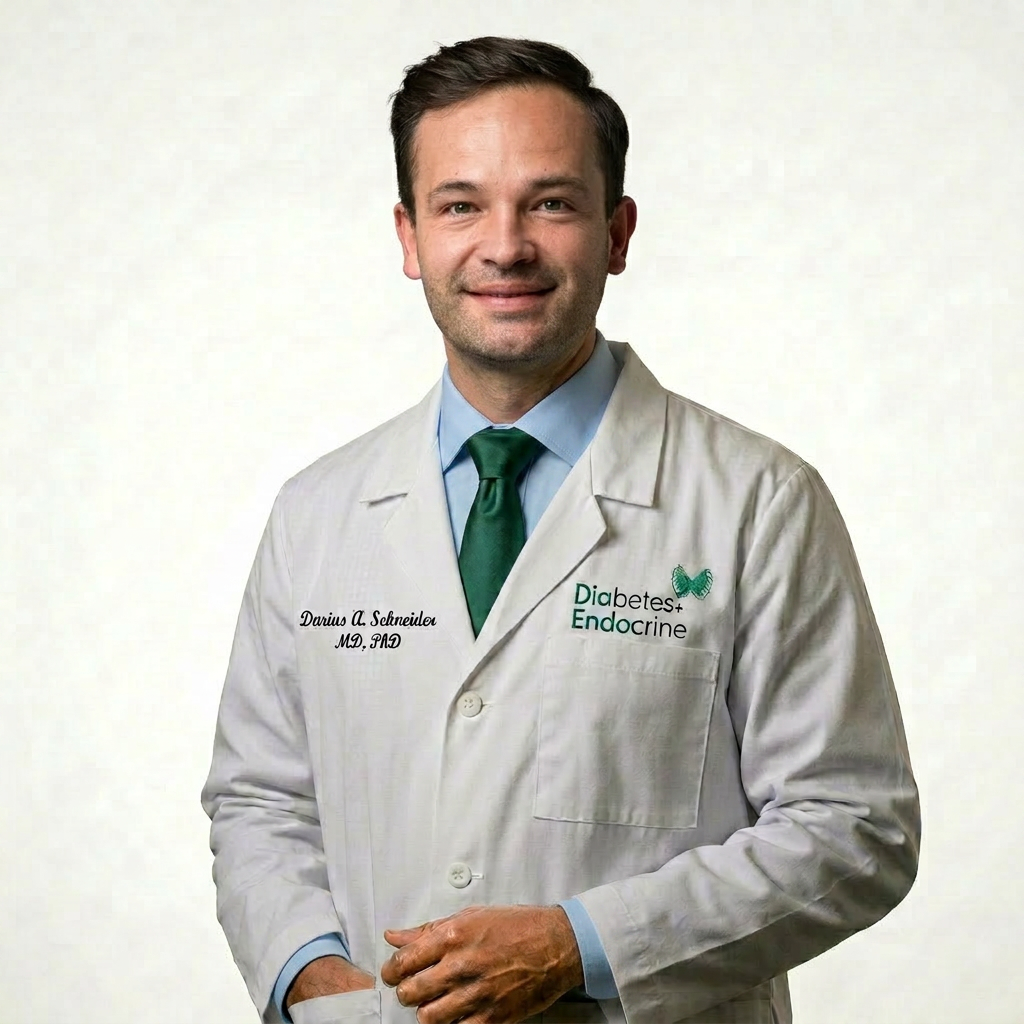
Darius A. Schneider, MD, PhD
Physician-scientist in interventional and general endocrinology, including diabetes, obesity and metabolic liver disease. He authors and maintains this MASLD/MASH resource.

Mba Uzoma Mba, MD, PhD
Endocrinologist caring for patients across the practice's San Diego offices, with a focus on evidence-based management of diabetes and cardiometabolic disease.
Three offices, one standard of care.
Fatty liver and MASH care is provided by Diabetes & Endocrine Specialists Medical Group.
Ready to treat the metabolism behind your fatty liver?
Board-certified endocrinologists. Physician-scientists. Straight answers about what helps the liver — and what protects the heart and kidneys too.